Why Immutable Storage Alone Is Not Cyber Resilience
Immutable storage has become one of the defining technologies in modern backup strategy. And for good reason: if backup data cannot be altered or deleted, ransomware attackers lose one of their most effective tactics.
But there’s a growing problem in the way organisations talk about immutability.
Too many businesses now treat immutable backups as synonymous with cyber resilience.
They are not the same thing.
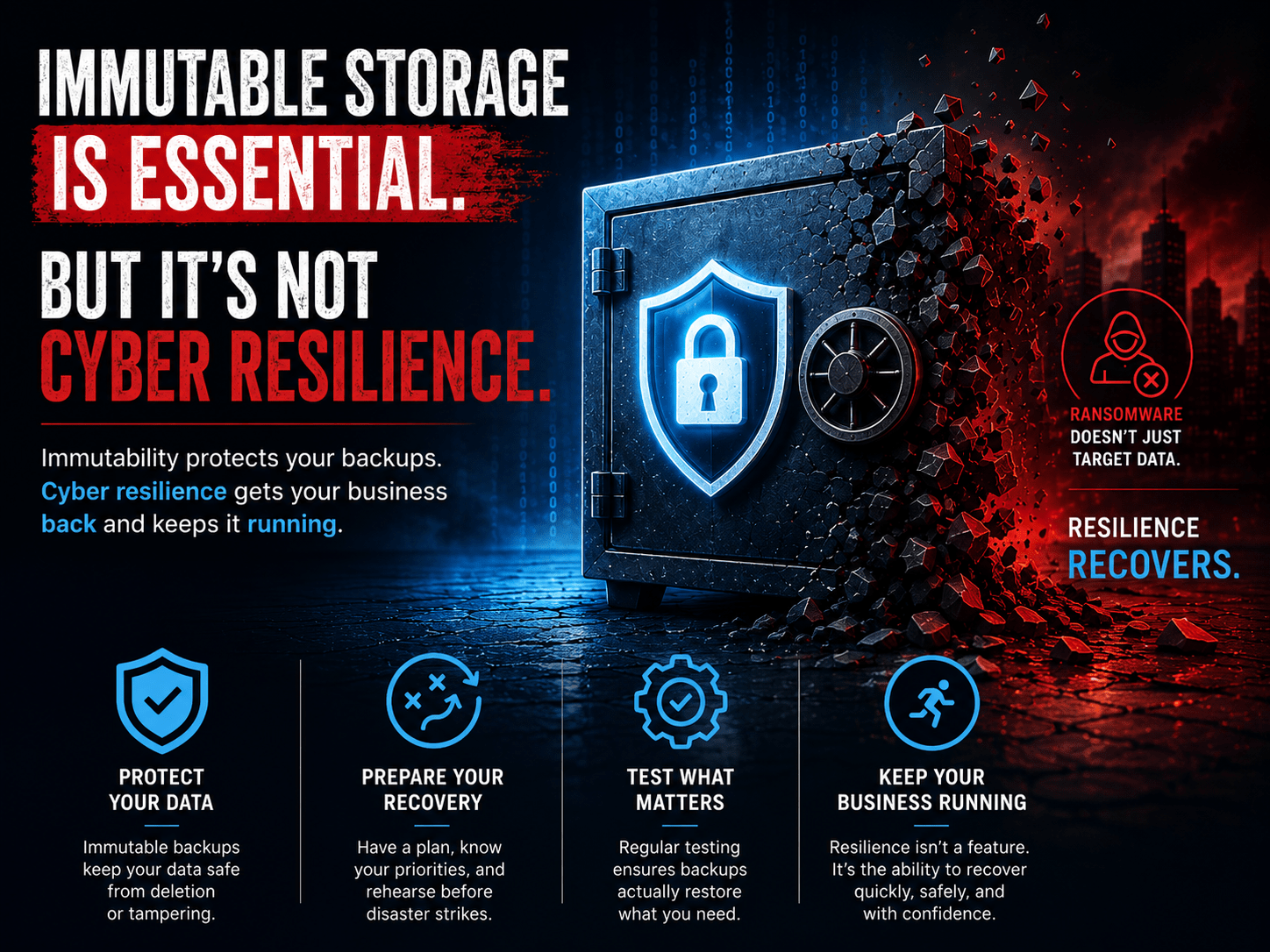
Immutability protects backup data. Cyber resilience ensures the business can recover and operate under pressure. Those are very different outcomes.
A backup platform can remain technically intact while recovery still fails.
The Dangerous Assumption
In many ransomware incidents, the issue is not that backups are missing. The issue is that recovery becomes operationally complex, delayed, or impossible within the required timeframe.
Attackers have evolved.
Modern ransomware groups increasingly target:
- privileged identities,
- orchestration systems,
- recovery infrastructure,
- authentication services,
- and operational processes.
The backup files may survive untouched. The environment around them often does not.
That distinction matters.
1. Compromised Credentials Can Defeat Recovery
Immutable storage does not protect against stolen administrative access.
If attackers compromise:
- backup admin accounts,
- API keys,
- privileged IAM roles,
- or orchestration platforms,
they may not need to delete backup data at all.
Instead, they can:
- disable jobs,
- alter retention policies,
- revoke access,
- destroy catalogues,
- or sabotage recovery workflows before encryption even begins.
In many incidents, organisations only discover this during recovery.
Resilience takeaway
Protect backup infrastructure like a Tier 0 security system:
- enforce MFA everywhere,
- isolate privileged access,
- use separate identity domains where possible,
- continuously monitor for abnormal admin behaviour.
2. Poisoned Backups Are Becoming More Common
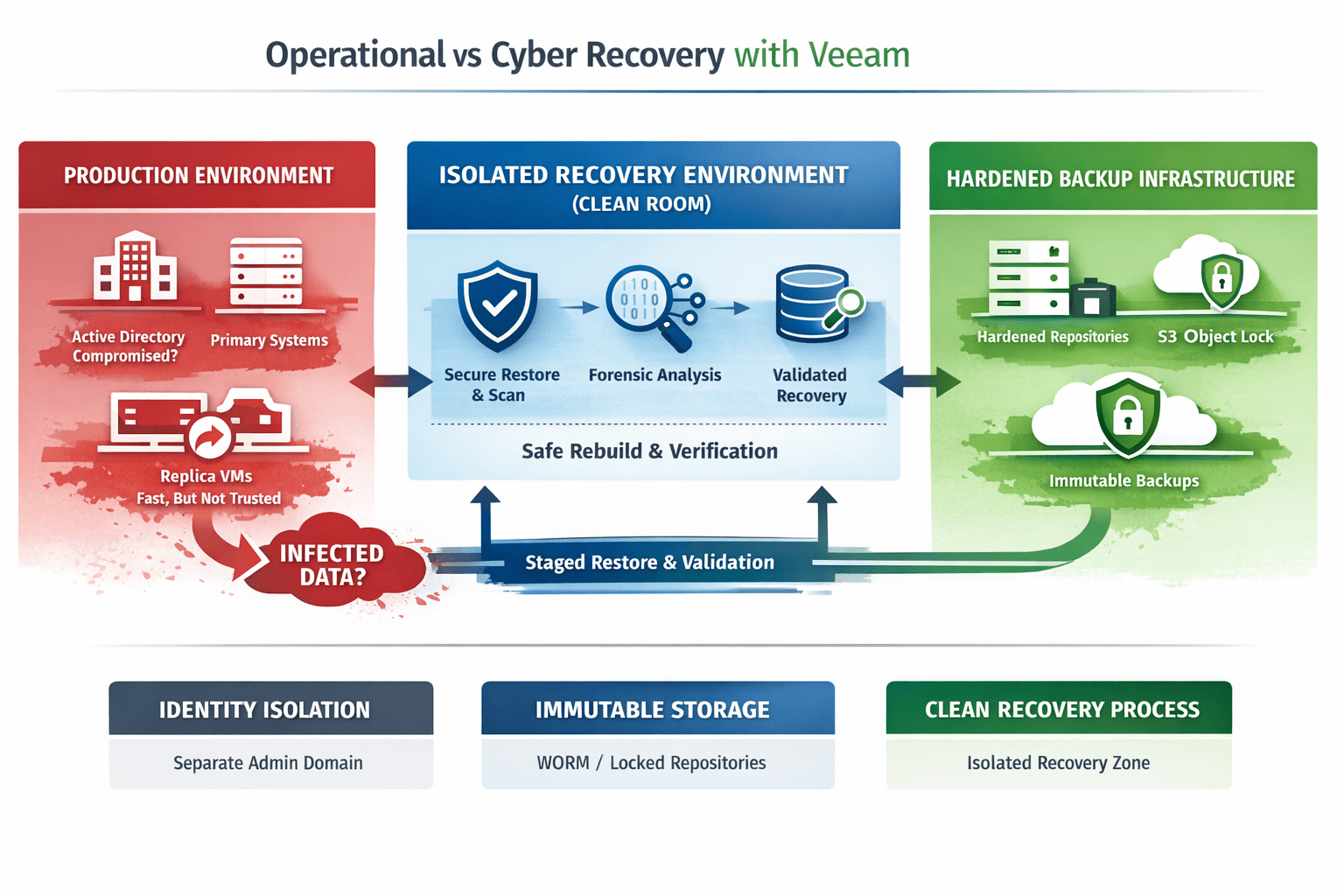
A backup can be immutable and still be unusable.
Attackers increasingly dwell inside environments for weeks before triggering ransomware. During that time, corrupted data, dormant malware, or malicious configuration changes can silently replicate into protected backups.
When recovery starts, organisations face a second crisis:
Which restore point is actually safe?
Without validation and testing, immutability may simply preserve compromised data permanently.
Resilience takeaway
Recovery assurance matters as much as backup retention:
- automate restore testing,
- scan backups for malware,
- validate application integrity,
- maintain known-good recovery points.
3. Orchestration Failures Break Real Recovery
Restoring data is not the same as restoring services.
Modern environments depend on:
- identity systems,
- DNS,
- cloud networking,
- SaaS integrations,
- certificates,
- automation tooling,
- and application dependencies.
A technically successful restore can still leave critical systems unusable.
This is where many recovery plans fail in practice: the backup worked, but the business could not operate.
Resilience takeaway
Recovery orchestration must be tested end-to-end:
- document dependency chains,
- test full service recovery,
- validate application functionality,
- rehearse real operational scenarios.
4. Insider Threats Still Exist
Immutability is designed primarily to defend against modification and deletion. It is not a complete defence against malicious insiders or compromised operators.
An attacker with sufficient access may:
- exfiltrate sensitive backup data,
- manipulate recovery priorities,
- disrupt infrastructure,
- or intentionally delay recovery efforts.
Cyber resilience must include governance, monitoring, separation of duties, and operational controls — not just storage policies.
Resilience takeaway
Build resilience around people and process as well as technology:
- implement least privilege,
- separate operational responsibilities,
- audit recovery actions,
- continuously review access rights.
5. Recovery Complexity Is the Real Risk
The biggest challenge during a ransomware incident is rarely “Do backups exist?”
The real question is:
“How quickly can the organisation return to business operations safely?”
That involves:
- prioritisation,
- communication,
- DFIR coordination,
- legal review,
- infrastructure rebuilds,
- identity recovery,
- application sequencing,
- and executive decision-making under pressure.
Immutable storage is one component of that process — not the entire strategy.
Cyber Resilience Is an Outcome, Not a Feature
The industry often markets resilience as a product capability.
In reality, resilience is the result of:
- preparation,
- architecture,
- testing,
- operational maturity,
- and recovery discipline.
Immutable storage is essential. Every modern backup strategy should include it.
But immutability alone does not guarantee recoverability.
Organisations that succeed during major incidents are the ones that continuously test recovery, secure backup operations, validate dependencies, and treat cyber recovery as a business function — not simply a storage feature.
Because when recovery becomes real, operational resilience matters far more than marketing terminology.