When Your Backup Software Talks to the Internet: AI, Veeam Intelligence, and the New Privacy Reality
A recent discussion on the Veeam R&D forums highlighted something that is going to become increasingly common in enterprise infrastructure: AI features that require your infrastructure data to be sent somewhere else for processing.
The thread in question discussed Veeam Intelligence, the AI assistant integrated into Veeam Backup & Replication and Veeam ONE.
Forum thread:
https://forums.veeam.com/veeam-backup-replication-f2/veeam-intelligence-t102502.html
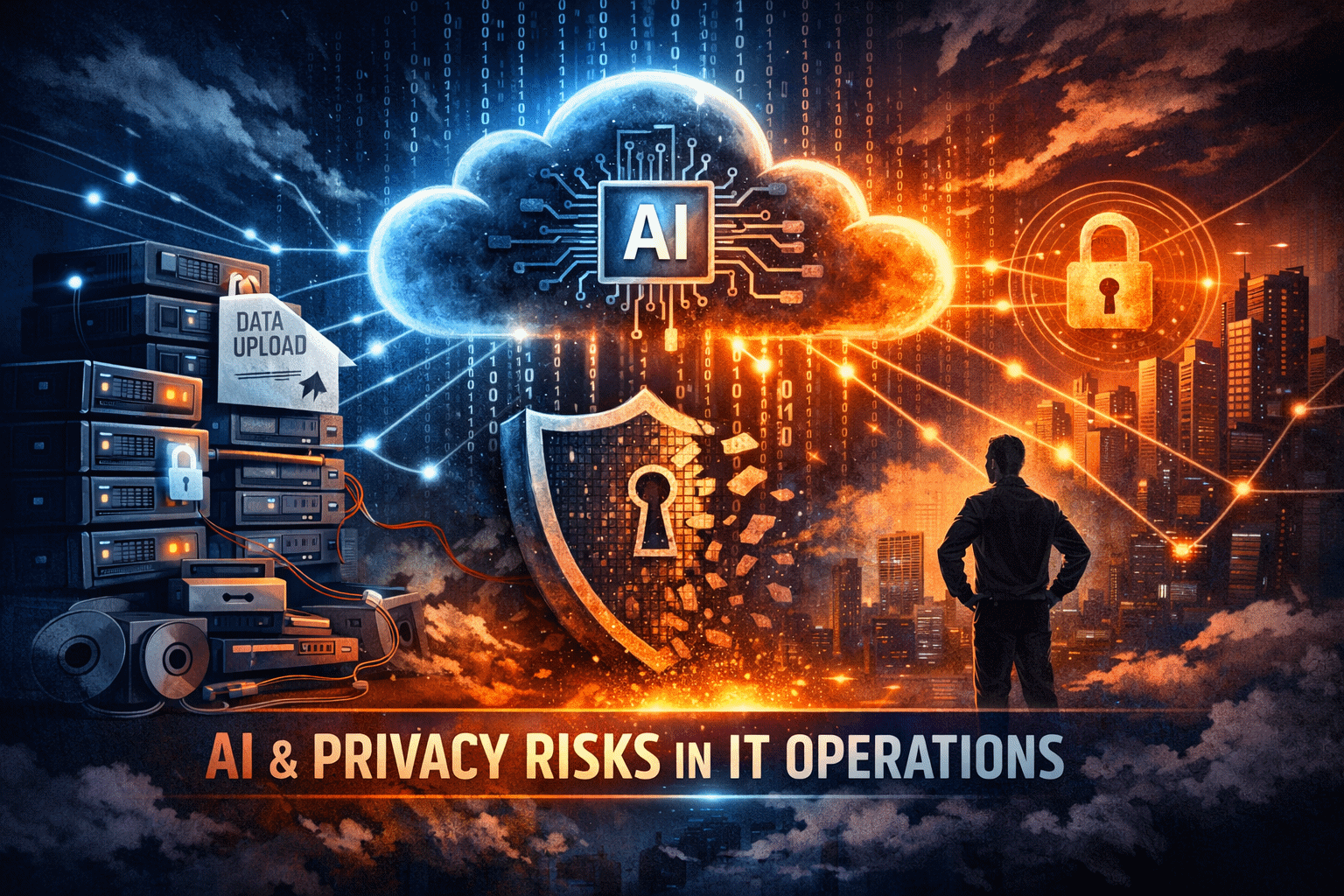
While the discussion was technical and fairly calm, it touches on a much bigger issue: AI fundamentally changes the data-flow model of technical operations tools.
What the Forum Discussion Revealed
The key takeaway from the discussion was that when Veeam Intelligence is enabled, data can be sent to Veeam servers, depending on the mode used.
From the discussion and documentation:
- Basic Mode
- Sends only the text of the user’s query to Veeam servers.
- Uses documentation and knowledge base content to generate answers.
- Advanced Mode
- Uses environment data via product APIs to generate environment-specific answers.
- This can include information such as:
- Backup jobs
- Protected VMs
- Storage and applications
- Alarms and monitoring data
- Infrastructure information
This behaviour is also documented in Veeam’s own documentation: the AI assistant can access infrastructure data via APIs to generate environment-aware responses.
In other words, the AI assistant is not just answering documentation questions — it may be analyzing your backup environment by sending API output to a cloud AI service.
That is a very different operational model from traditional backup software.
The Important Line From the Forum
One of the most telling responses in the thread was essentially:
If in doubt: don’t use it.
That line sums up the current state of AI features in infrastructure software surprisingly well.
Not because vendors are doing anything malicious — but because the data flows are complex, evolving, and often not fully transparent to administrators.
AI Changes the Trust Boundary
Historically, backup software had a very clear trust model:
- Backup server
- Backup storage
- Tape / offsite
- Admin console
- Everything inside your network
AI assistants break that model.
Now the workflow may look like this:
- Admin asks a question
- Software queries internal APIs
- API output is packaged
- Data is sent over HTTPS to vendor AI service
- AI processes it
- Response returned
Even if data is anonymised or redacted, the backup environment metadata itself is extremely sensitive:
- Server names
- Job names
- VM names
- Network structure
- Storage layout
- Alarm data
- Backup failures
- Retention policies
- Repository locations
From a security perspective, this is effectively a blueprint of your disaster recovery strategy leaving your network.
The Bigger Issue: AI in Technical Operations
This is not about Veeam specifically.
This is about AI in operational tooling.
The same pattern is now appearing in:
- Backup software
- Monitoring platforms
- SIEM tools
- DevOps platforms
- Cloud management tools
- Documentation platforms
- Ticketing systems
- Code repositories
- Network monitoring tools
AI assistants work best when they have context, and context means data, and data means data leaving your environment.
This creates several new challenges:
1. Data Sovereignty
Where is the AI processing happening?
Which country?
Which legal jurisdiction?
2. Data Retention
Is the data stored?
For how long?
Is it used to train models?
3. Change Over Time
One forum comment pointed out something very important:
What is sent today may change in a future update.
That is a huge operational governance problem.
4. Invisible Data Flows
Traditional tools:
- You know when logs are exported
- You know when backups are copied
- You know when replication occurs
AI tools:
- Data flows when someone asks a question
- Data flows when AI analyzes logs
- Data flows when AI generates recommendations
- Data flows in the background
This is a completely new operational risk category.
The New Question for Infrastructure Teams
We used to ask:
Is this tool secure?
Now we have to ask:
What data leaves our environment when this tool uses AI?
That is a very different question.
And most organizations do not yet have governance policies for this.
Practical Recommendations for Organizations
If you are running enterprise infrastructure and AI features are appearing in your tools, you probably need new policies:
- Treat AI assistants like external services.
- Review what data is transmitted.
- Check retention policies.
- Decide whether AI features are allowed in production environments.
- Consider enabling AI only in test environments.
- Monitor outbound connections from infrastructure servers.
- Include AI data flows in security reviews.
- Document AI features in risk registers.
- Inform compliance and legal teams.
- Assume AI features will expand over time.
The Bigger Picture
The Veeam forum discussion is interesting not because of Veeam specifically, but because it shows something important:
AI is quietly changing how infrastructure software works.
Not in the UI.
Not in the features.
But in where your operational data goes.
For the last 30 years, infrastructure tools mostly ran inside your network.
AI tools do not.
And that is going to be one of the biggest operational and security shifts in enterprise IT over the next decade.
Final Thought
Backups are supposed to be the last line of defence — the one system that absolutely must be isolated, controlled, and secure.
If AI assistants connected to backup infrastructure start exporting environment metadata to external services, even for legitimate reasons, then organizations need to think very carefully about where the new trust boundary actually is.
Because with AI-enabled infrastructure tools, your backup environment may no longer be entirely inside your network — even if the servers are.