
Backup Acceleration, Restore Reality, and Why Replication Matters for Business Continuity
There’s a growing trend in the enterprise backup market where vendors are introducing “backup acceleration appliances.” When you strip away the marketing, most of these are essentially very fast NVMe landing zones that sit in front of slower backup storage. They act like a write cache for backups — ingest data quickly, then move it to slower storage later.
These devices absolutely have a place, but it’s important to understand what problem they actually solve, and what they don’t.
Backup Acceleration: Solving the Backup Window Problem
In many environments, the biggest backup challenge is still the backup window. Large data volumes, high change rates, and slower deduplicated or object storage repositories mean backups can run into business hours or impact production systems.
A fast NVMe landing zone solves this by allowing backup jobs to write at very high speed. The data is then de-staged to slower storage in the background after the backup job has completed. From the backup server’s perspective, the job finishes much sooner.
This can shrink backup windows, reduce load on production systems, and prevent backups running into business hours. For backup ingestion performance, this is a very effective solution.
The Important Reality: It Doesn’t Help Restore Speeds
Where buyers need to be careful is assuming that faster backups automatically mean faster restores. In most architectures, once the backup data has been moved from the NVMe landing zone to the main backup repository, restores still have to come from that slower storage and often involve rehydrating compressed or deduplicated data.
So while backup jobs finish faster, restore times are often unchanged.
This highlights a critical point that is often misunderstood in backup design: backup performance and restore performance are completely different engineering problems. Backup acceleration appliances solve backup ingest bottlenecks, not recovery time objectives.
Backup vs Business Continuity
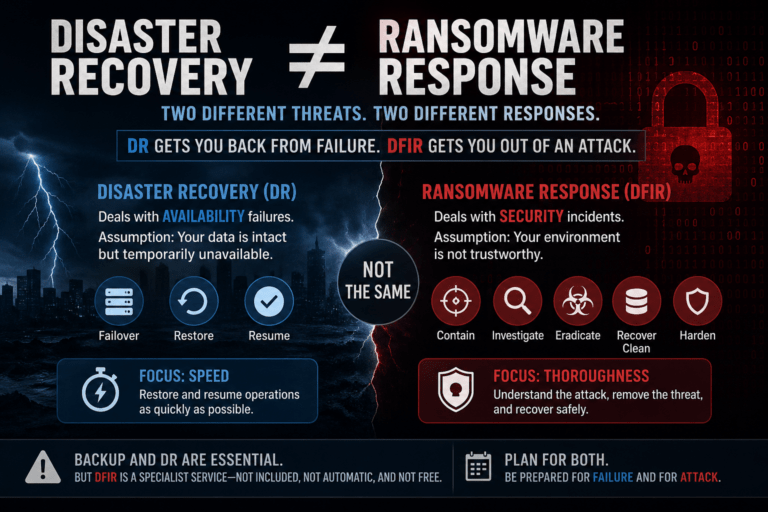
This leads to a bigger architectural issue: backups are often treated as the entire disaster recovery strategy. They are not. Backups are for retention, rollback, and protection. They are not designed for rapid recovery of entire platforms.
If the business requirement is fast recovery and low downtime, replication needs to be part of the solution. Replication keeps a near-live copy of systems in another location so recovery becomes a failover operation rather than a full restore.
The simplest way to think about it is:
Backup = Data Protection
Replication = Business Continuity
You still need backups for retention, compliance, and ransomware recovery, but backups alone are not a business continuity strategy.
The Real Takeaway
Backup acceleration appliances are useful for shrinking backup windows and solving ingest performance problems, but they will not significantly improve restore speeds. If the real requirement is faster recovery, the discussion should move beyond backup storage and toward replication and recovery architecture.
Because ultimately, the business does not care how fast backups run — they care how fast systems come back.